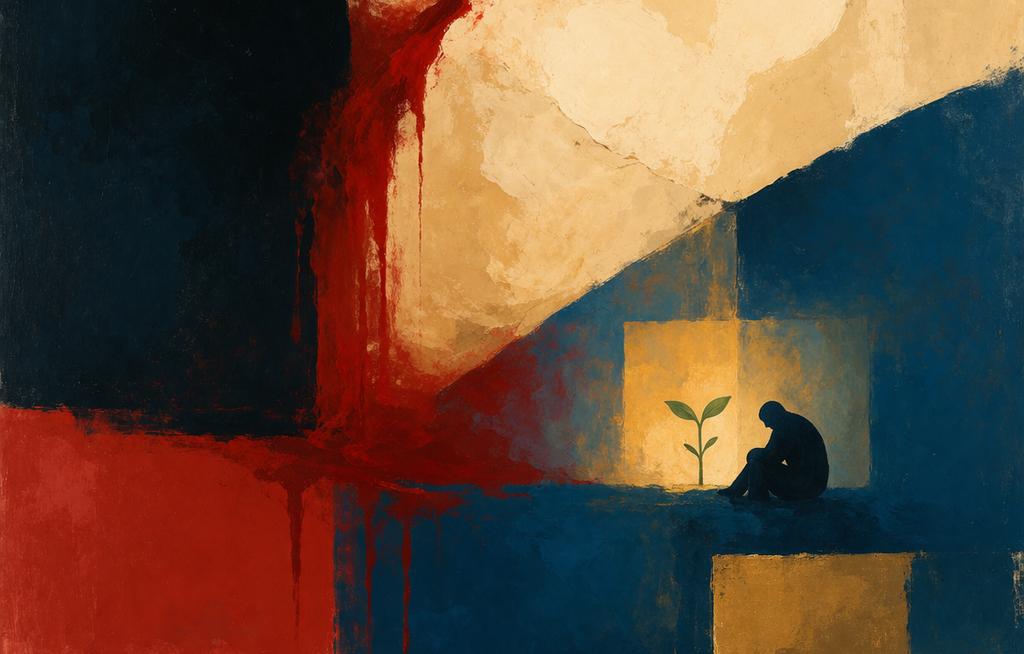

A lot of mainstream anime and manga these days openly deal with social cruelty and the darker sides of life. They’re not just the old soft hero stories or effort-will-save-you stories anymore, which I think is good. But most of the time, they don’t actually solve anything, do they? They show how messed up society is, resonate with people who already feel that way, a lot of drama happens, and in the end the characters just keep living while carrying unresolved injustice and unresolved pain. Is that basically where things are now?
I think so.
Broadly speaking, a lot of mainstream anime and manga today are willing to say, society itself is broken.
But they rarely go as far as saying, and then the whole system was changed.
Heavy themes have become normal. Exploitation, bullying, structural violence, family damage, poverty, online cruelty, institutional decay—these are no longer confined to a niche category of “dark” works. They’ve become visible in mainstream storytelling too.
But as you said, the problems usually aren’t resolved.
And I don’t think that’s simply because creators have become more pessimistic. It’s also because the problems being depicted now are the kind that can’t be fixed by one strong protagonist trying harder. Black labor, broken industries, distorted families, systemic inequality, social exhaustion, internet violence—these don’t disappear just because one person grows stronger.
So the emotional destination of these stories has shifted.
Instead of, we won and everything got better, it’s more like:
・someone refuses to abandon someone else
・a damaged relationship is repaired just a little
・someone escapes, takes distance, survives
・life continues without pretending everything is okay
In other words, these are often no longer stories of revolution. They’re stories of survival.
I think that’s where many mainstream works place their emotional core now.
And part of the reason is probably that audiences no longer believe so easily in stories that say, if you work hard enough, everything can change. That kind of promise doesn’t land the same way anymore. People are more likely to believe in damage, endurance, compromise, partial repair.
That said, I don’t think these works are simply selling helplessness.
If anything, a lot of them are built around this balance:
the problem remains unsolved, but the emotion is still carried somewhere.
The world remains what it is. The system remains what it is.
But a character breaks, meets someone, finds a few words, shifts their position just slightly.
So even if the viewer is left thinking, none of this really fixed reality, they can still feel, it wasn’t meaningless.
I think that’s one of the dominant emotional structures now.
Older hero stories carried the hope that the world can be changed.
A lot of stories now carry a different kind of hope:
the world may not change anytime soon, but maybe you can remain unbroken inside it.
So yes, I think your summary is close.
A lot of stories now follow this pattern:
・they depict injustice
・they gather empathy
・major drama erupts
・the structure itself mostly remains
・and the characters keep living among the ruins
If older stories were stories of victory,
a lot of current ones are stories of endurance.
And I don’t think that means they’re worse.
It may simply reflect the mood of the time.
In an era that no longer trusts society very much, “surviving anyway” can feel more honest than total resolution.
Both, I think.
There really were periods when things changed.
But at the same time, the feeling that society could be changed is also something memory tends to idealize afterward.
So no, the past wasn’t pure fantasy. There were moments when collective action genuinely moved laws, institutions, and public life. People weren’t simply deluded when they felt history could be pushed.
Especially in the postwar period through the 1960s and 70s, there was a stronger sense that history itself was in motion. Civil rights, labor movements, antiwar movements, feminist movements, student protests—there were visible moments when the system responded, even if partially, even if imperfectly.
So the older belief that society could be changed wasn’t just naive optimism. It came from real experiences of pressure producing visible effects.
But even then, it wasn’t as if everything could be changed.
That period is remembered because much changed—but also because so much didn’t. Success and failure were always mixed together.
I think the difference between then and now is less about whether people are more capable or less capable, and more about the atmosphere.
Today, systems, institutions, corporations, and platforms have become so large and entangled that even when something changes locally, the overall structure still feels immovable. People can still act, but it’s harder to feel that action reaches the level of the whole.
So the feeling is something like this:
Then: there were more visible moments that made change feel possible.
Now: even when something changes in one place, the larger structure still feels rigid.
So the hope of the past was not merely an illusion.
But it also gets remembered through a slightly idealized glow—the glow of a time when the future still felt more reachable.
More precisely:
people in the past had more visible reasons to believe change was possible.
But the past was never all-powerful either.
Maybe one reason contemporary stories lean toward nothing is fully solved, but life continues is not that people have become weaker. Maybe it’s also because the structure has become too visible.
It really is a lot like fat.
And honestly, that metaphor gets at something essential.
A bloated social system contains a lot of things that look unnecessary.
But the body as it currently exists has also been built with those things still attached.
So from the outside, certain departments, customs, procedures, institutions, and industry structures can look absurd. You want to ask, Do we really need this? But in practice, if you strip them away too quickly, something else starts bleeding.
That’s why it resembles visceral fat so well.
It may look ugly, excessive, unnecessary. But if it has been part of the body for a long time, ripping it out all at once shocks the whole organism.
So yes, if you stop it all at once, something often does break.
But the interesting part is this:
just because removing it causes damage does not mean every part of it was necessary.
That’s what makes it so difficult.
Some of it was genuinely wasteful.
But that waste was also acting as cushioning.
Some of it created inefficiency.
But that inefficiency also prevented sudden collapse.
So the “fat” of a social system is not just useless excess.
It’s inertia, insurance, padding, vested interest, laziness, habit—all mixed together.
That’s why cutting it away does not automatically make the body healthy.
But leaving it untouched means it keeps getting heavier.
It really is like this:
・you know weight loss would help
・but doing it too fast is dangerous
・and in the meantime the body says, this is too much trouble
And society is even more troublesome than a human body, because even if everyone vaguely agrees the system should slim down, the next question is always:
Who exactly has to give something up?
If we cut this institution, who gets hurt?
If we remove this subsidy, what dies with it?
If we get rid of this intermediary structure, what stops functioning?
If we drop this outdated rule, who takes responsibility?
That’s why even when everyone senses that something has become fat, no one wants to pick up the knife.
And what makes the metaphor especially accurate is this:
people know it’s heavy, but it has become so embedded in daily life that it no longer feels like an external burden. It starts to feel like part of the self.
The same thing happens socially.
When wasteful rules and overgrown systems remain in place long enough, people begin to mistake them for reality itself.
So changing them starts to feel less like reform and more like self-harm.
That’s why, if we stay with the metaphor, what we really need is not liposuction.
We need a slow change in metabolism.
Socially, that would mean things like:
・clarifying roles
・simplifying procedures
・experimenting at a small scale
・updating systems in ways that won’t become fatal if they fail
・not trying to jump instantly to the ideal form
So in the end, it’s simple:
If you tear it off suddenly, things break.
If you leave it alone forever, the body keeps getting duller.
So the only real path is gradual metabolic change, even if it’s boring and exhausting.
It really is just dieting.
And maybe one of the reasons modern life feels so miserable is that everyone more or less knows this, yet keeps repeating:
I’m busy today too. Let’s just leave it for now.
That, too, feels very much like fat.
Yes. I think that reading makes a lot of sense.
Those tragic, hyper-competent antagonists are often people who have seen the ugliness of the world too clearly.
And because they’ve seen it so clearly, they stop trying to defeat an external enemy and start operating on the world itself.
But the world is not made of fat alone.
If you cut into it, it bleeds.
Attached to that “fat” are ordinary lives, weak people, daily habits, dependencies, and small forms of care. So even if the antagonist is not entirely wrong, the result is catastrophe.
That’s why so many recent stories are no longer simple good-versus-evil narratives.
They tend to follow a structure more like this:
・society is rotten
・leaving it untouched is also wrong
・but cutting into it radically causes massive bleeding
・so the antagonist’s anger is not entirely unjustified
・yet their method is catastrophic
・That’s where the blood starts flying.
And then, as you said, the landing point becomes visible from far away.
In the end it usually turns into one of two things:
・the whole thing won’t change, but maybe it can become slightly less terrible
・or we return to some form of individual salvation
I think that’s what you’re getting tired of.
The critique is radical, but the resolution ends up familiar.
So then the question becomes: what else is there?
And maybe what’s really missing is a third texture—something that is neither destruction nor resignation.
Not changing the whole world.
Not merely adapting to it and enduring it.
Not retreating completely into a tiny private sphere either.
Something in between.
And that brings us to your last question:
what can an individual actually do inside a bloated social system?
Honestly, not very glamorous things.
But maybe precisely because they’re unglamorous, they’re real.
One thing is learning to distinguish what is fat and what is organ.
When people get angry, they tend to want to cut away everything. But reality isn’t that simple. Some things are tedious but necessary. Some things are rotten but cannot be removed overnight. Some things do need to be cut immediately. Being careful about those distinctions matters. Crude justice leads to bleeding very quickly.
Another thing is reducing the small systems one unconsciously reproduces oneself.
Even if an individual cannot transform society as a whole, each person still reproduces small bureaucracies, small conformisms, small exploitations, small vanities, small lazinesses in everyday life.
The first thing you can touch is the radius around yourself.
Then there’s building small alternatives.
If all you do is criticize the larger system, you remain parasitic on it.
But if you create even a small different way of doing things, then for the first time you begin to see what a body with less fat might actually move like.
A small community.
A different kind of work relation.
A different kind of social space.
A different kind of bond.
Maybe the world changes less through revolution than through these small local changes in metabolism.
And another important thing, surprisingly enough, is simply not breaking.
That sounds passive, but I don’t think it is.
A great deal of the current system sustains itself by wearing people down and producing exhausted human beings. So resting properly, not becoming numb, not abandoning one’s senses, not losing one’s own words—those things are not just self-care. They are a form of resistance.
So if I had to condense it, I’d say this:
What individuals can do is not to cut everything open.
It is to distinguish carefully, reduce what they themselves reproduce, create small alternative circuits, and refuse to break.
It isn’t dramatic.
You can’t slash the world open like an anime villain.
But in reality, that may also be the limit of what an individual can truthfully do.
And when people skip over that limit and rush straight to major surgery, they usually end up destroying both themselves and others.
Maybe that’s also the kind of story we’re still missing.
Not blood spray.
Not spectacular collapse.
But the question of how, inside a damaged body, a different metabolism might slowly be made.
There still aren’t many stories that do that well.